Friday, December 28, 2012

Before dogs...

...came horses.  Here are a few of many I rode over the years.

This is Arabian pony Dan.  Everyone took their first lesson on Dan the pony.  I'm not sure why I was wearing red pants.


This is Jim Dandy-he was a Foxtrotter which didn't make him a great hunter, but he was a good kid's lesson horse.  This picture was taken on costume day at horse camp.

 The next one is Bridy who I think was an ex-racehorse.


 Sweet William was old for as long as anyone could remember, but he was still good for smaller jumps.

This one is Zoom-a middle aged Morgan.  He was one of my favorites.  Definitely not your classic hunter type horse but you could ride him all day long, he could jump with the big horses and was great on trails.  But he was impossible to catch in pasture.  Excuse my helmet hair.
Toshea-another Arabian pony.  She was pretty fancy for a lesson horse but was afraid of blue and red jumps.  It took a well timed whack with a crop to get her over those.  I believe this problem improved with time.

Dozer was a privately owned horse that I rode for awhile.
The one I don't have pictures of for some reason was my all-time favorite pony, Cassie.  She was a cute little buckskin mare who came from a bad home to join the lesson barn.  She had one foal while she was there (a palomino which surprised everyone since the sire was a dark bay thoroughbred).  I also spent some time riding the filly, Cream.

This last one is Willy.  He was also privately owned and the nicest horse I ever rode.  Pretty much all I had to do was not fall off and collect blue ribbons.  As much fun as that was it is one of the reasons I prefer agility these days.  Often, in horses, the most expensive horse wins.  This is not the case in agility.  It's a bit of a more even playing field.
Dan and William lived the rest of their days at the lesson barn.  Zoom, Cassie, Cream, and Willie were all eventually sold.  Dozer was donated to a college program.  And I don't know or don't remember what happened to Toshea, Bridy, and Jim Dandy.

Thursday, December 27, 2012

Pork Work

Sometimes, pot-bellied pigs need their hooves or tusks trimmed.  Like most other sane people I prefer not to work on pigs of any variety.  When I was in school I used to just drop them off in the food animal area of the teaching hospital, apologize to whichever students were on that rotation and then leave for an hour.  Worked out great...for me.

Then, of course, I graduated and was on my own.  Fortunately Touchdown is a female (who don't grow much in the way of tusks) and male tusks don't grow as much as they age so I never had to anything with Spadias before he died a few years ago.  Then along came young Jimmy Dean.

JD had one tusk (don't ask my why just one) growing out that needed trimmed.  I have been trying to ignore this for a number of months but it had reached the point of almost curling back around into his face so the time had finally come to do some pork work.

Now, pigs do not like to be stuck with needles.  Also, pigs have very tough, thick skin.  So there is no quick stick before they know what is happening.  Pig must either be trapped somewhere or manhandled.  We did not have a place to trap him so we went with manhandle.  Jerry held him up while I harpooned him with my cocktail of drugs.  Then we waited.  And waited.

There were a lot of suggested drug doses for sedating pigs so I just picked one based on the drugs I had available to me.  Also I used an estimated weight.  Either the weight was too low or the dosage I chose was too low because JD never went all the way out. He remained in that haphazard state between awake and asleep where everything makes them freak out and yet they are unable to actually  freak out very effectively. He was drunk enough to be able to be held down but awake enough to scream and kick.  Nonetheless we were successfully able to trim the tusk and the feet.  I suggested Jerry drill a hole in the tusk and make a necklace.  He said he doesn't really wear necklaces.
Then, because it's not recommended to leave a heavily sedated animal out in the cold to sleep it off we drug him on a tarp to the garage.  I'm not sure how he felt about this trip but we did it anyway.  However, he really didn't want to just rest and kept staggering around the garage.  Since he wouldn't stay still Jerry decided to take him back out the yard-this time he just carried him...with minimal screaming (by the pig that is, not Jerry).   He (again the pig, not Jerry) spent the next few hours staggering around but otherwise recovered uneventfully.

Hopefully that is the last of my pork work for a few years.  But doesn't he look better now without a snaggletooth growing into his face?

Wednesday, December 26, 2012

Parasites Part 2: Hookworms

Hookworms-these are the blood suckers!  But lets start at the beginning.  Hookworm eggs pass out of the dog in the stool and contaminate the environment.  Once there, the eggs develop into the infective larval stage.  This process depends on weather conditions but typically takes 1-2 weeks. The infective stage enters the dog by one of four methods-ingestion of the larvae while cleaning/grooming itself, ingestion of another animal with encysted larvae, skin penetration, or transmammary.

Ingestion of the larvae results in one of two scenarios.  In the simple version the larvae continue to the intestinal tract and remain there where they mature and reproduce, perpetuating the life cycle.  Sometimes though  the ingested larvae are more adventurous and migrate to the respiratory tract where they are coughed up and swallowed just as in the roundworm life cycle.  Once back in the intestines, they mature and continue like normal.  In the ingestion of the secondary host the encysted larvae are released into the intestines of the dog where they also mature.
Hookworms in the intestine


When the adventurous larvae mentioned above travel to the respiratory tract they don't all make it, and end up encysted in various tissues in the body.  These encysted larvae account for the last scenario.  Pregnancy, for some reason, causes the larvae to come out of the cyst and travel to the mammary gland and the puppies are affected through nursing.

Mature hookworms attach to the intestinal wall and feed off the hosts blood.  This can cause a severe anemia (low red blood cell count) in puppies.  Severely infections can require intensive care, blood transfusions and may even result in death.  Fortunately hookworms are susceptible to most common dewormers.  Deworming puppies every  2 weeks for several weeks will usually clear the infection.  Most heartworm preventatives also deworm for hookworms monthly.
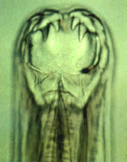
Hookworm teeth


Hookworms are small (about 1/2-3/4 inches long) and are rarely seen in stool.  This is due not only to their small size but also because they attach so firmly to the intestines that live worms do not often pass in the stool.  Diagnosis is usually made by seeing the eggs on a fecal flotation.  Hookworm eggs can only survive a few months in the environment and are killed by freezing.
Hookworm egg


Zoonotic potential
Hookworms can also affect humans.  Most common cause is by penetration of the skin-especially from walking barefoot through contaminated soil or sand.  This causes a very itchy, but typically treatable, skin lesion. Common sense and good hygiene will help prevent this.


Tuesday, December 18, 2012

Parasites Part 1: Roundworms

Who doesn't like bugs right?  Here goes...

Roundworms (toxocara species) are common intestinal parasites of puppies and kittens but can also infect pets of any age.  These are the "spaghetti" like worms that can be seen with the naked eye.

Adult Roundworms
So how do pets get infected?  Roundworm eggs are passed in an infected animal's feces and then live in the soil.  The eggs in fresh feces are not infective.  It actually takes about a month for the eggs to become infective and once they reach that stage they are also very resistant to harsh environmental and weather conditions and can remain infective for months or years.

Usually a dog ingests the eggs through normal grooming after picking up the eggs on their paws or fur while outside.  Once ingested, the larvae hatches out and burrows its way out of the intestines.  Some travel to the liver and become encysted, sometimes for years.  The rest travel to the lungs where they are coughed up and swallowed and return, once again, to the intestinal tract.  Once back in the intestines they mature and begin to reproduce and lay eggs, which are passed in the feces and the cycle begins again.  When the encysted larvae move out of the liver, they travel to the lungs as the others do and the life cycle continues.  It seems unclear (at least I wasn't able to find a good answer) as to why some larvae encyst and some don't although encysting seems more common in older puppies or adult dogs.  It also seems unclear, other than gestation) what factors cause the encysted larvae to begin migration.

If the infected dog happens to be pregnant or nursing then when the larvae leave the liver they travel to the uterus or mammary glands instead of the lungs.  In the uterus they can be passed to the puppies before birth. They can also be passed to nursing puppies through the milk but these puppies were likely infected in utero anyway.

Rodents or other animals can also ingest infective eggs.  In this case they larvae encyst and remain that way until the rodent is eaten by a dog and then the life cycle proceeds as above.

Roundworms can cause diarrhea and vomiting, or in severe cases pneumonia or intestinal obstruction.   They also account for those underweight, pot-bellied puppies with dull dry coats.  Roundworms are diagnosed by observing them in the stool or vomit or by identifying the eggs on fecal flotation.  It should be assumed that all puppies are born with roundworms.
Roundworm egg


Roundworms are easily treated  as most available deworming products are effective against roundworms and many heartworm preventatives also treat roundworms.  These products however, are only effective against the intestinal stage of roundworms, not the encysted stage.  This is why even with a routinely dewormed female dog, the puppies are still born with roundworms as pregnancy seems to cause the encysted stages to begin migration.

Also a minimum of two dewormings at least 2 weeks apart are needed to treat a roundworm infection because the length of the life cycle and the lack of efficacy of dewormers on the non-intestinal stages.  Cleaning up the stools of any infected pet will also limit the contamination of the environment, thus limiting future infections.

Zoonotic potential
Zoonotic diseases or parasites are ones that can be transmitted to humans.  Roundworms are one of the more serious parasites than can do this.  Children are most at risk and typically become infected by inadvertently ingesting infective eggs (think playground dirt and sandboxes!).  Once ingested the worm tries to complete its life cycle but get lost since they are not in their natural host. They often end up in the abdominal organs or more commonly in the eye-which can result is serious disease or permanent blindness.  This can be prevented by limiting contact with soil, sand, etc and routing hand washing.

Saturday, December 15, 2012

Thursday, December 13, 2012

Decision 2012

After much consideration I have decided to move Legend to AKC 16 inch preferred and NADAC 16 inch veterans starting next year.  We were supposed to head to a NADAC trial this weekend but extenuating circumstances have made than impractical so no agility until February.

Anyway, the move in NADAC was sort of a no-brainer since all the points from all the categories count together for a NATCH.  I really wanted to earn all the regular and jumpers points at her natural jump height (and now all those are taken care of) but course time and jump height don't factor in that much for chances so I'm ok with doing the rest of those at the veterans level.

AKC came as a harder decision.  I entertained the though of trying to go to Nationals again and/or get a second MACH but with the limited number of trials we have been going to and the ongoing contact issue I wasn't sure I wanted to put that kind of stress on myself or my dog.  So, we are going to do preferred.  With the new rule change I could just transfer her directly in masters classes but I think half the fun of doing preferred is getting to start in novice with a trained dog!  And since we don't really have any goals anyway, why not?  And if I want to try to go to nationals someday we can do so in the preferred division.  I know it's not the same but since we just do it for the fun and the experience anyway it doesn't really matter.

So there you have it-my big decision for the year!

Wednesday, December 12, 2012

A lesson

A wise man once taught us this African proverb...

Every morning in Africa a gazelle wakes up. 
 It knows it must outrun the fastest lion or it will be killed.

Every morning in Africa a lion wakes up.
It knows it must outrun the slowest gazelle or it will starve.

It doesn't matter whether you are a lion or a gazelle,
when the sun comes, you better be running.


I could have slept in this morning.  I didn't.

Monday, December 10, 2012

There's an app for that

I got a new app for my phone. It's called InstaCollage. It's a great way to kill time when it's slow at work.


Sunday, December 9, 2012

Back to back...and then some

Friday night Legend got to run her first 5K with me!  The starting gun and taking off in a mass of people had her a little out of sorts at first but eventually she settled in and the crowd thinned out.  And she did great-I think she really had a good time and didn't seem the least bit bothered by running harder than we usually do in training.  In fact we picked up 2nd place in my age group (she was probably the first dog but no prize for that!).

Then we turned around and did it all again Saturday morning!  This time for the Frosty Paws run which benefited the Boxer/Schnauzer rescue of the Ozarks so there were lots of dogs present.  Once again she did a great job and we picked up third place in the female with dog category.

As if that wasn't enough fun for the weekend Cheri, Jerry, and I headed down to Branson to meet my family at Silver Dollar City.  Apparently, the unseasonably warm weather was bringing droves of people to SDC this weekend and we got stuck in an insane line of traffic.  After traveling about 1/2 mile in 45 minutes we began contemplating just parking the car and walking the remaining 1.5-2 miles.  As we continued to creep along this seemed like a more and more plausible plan so as soon as we found an acceptably wide and safe looking shoulder we ditched the car and hiked it on in.  We arrived much sooner than if we had stayed in the car and since my family was already at the park we knew we had a ride back to our car once we were all ready to leave.  We thought this was pretty creative problem solving but the parents were a little less than impressed with our decision.  In fact I think terms like crazy, stupid and "you did what" were used.  Anyway, we then spent the next five hours tromping around SDC, waiting in various lines and enjoying the rides in the dark-extra fun that way!  After which we were returned to our car which was unticketed and unharmed right were we left it.

Today, I am doing nothing.